
 Ask Me !!

Authentication in Cryptography
Definition of Authentication
Authentication in cryptography verifies the identity of a user, device, or system. It ensures that the entity requesting access is genuinely who they claim to be, preventing unauthorized users from accessing sensitive information or systems.
Methods to Achieve Authentication
Several cryptographic techniques are used to authenticate entities and secure communications:
- Passwords and PINs: Simple forms of authentication that verify user identity based on knowledge, though often combined with other methods for greater security.
- Digital Certificates: Certificates issued by trusted Certificate Authorities (CAs) bind a public key to an entity, helping to verify identity through cryptographic means.
- Multi-Factor Authentication (MFA): Combines multiple authentication factors, such as passwords, biometrics, and hardware tokens, to improve security by requiring multiple proofs of identity.
Role of Digital Signatures and Certificates
Digital signatures and certificates play a crucial role in authentication, especially in verifying identities over unsecured networks:
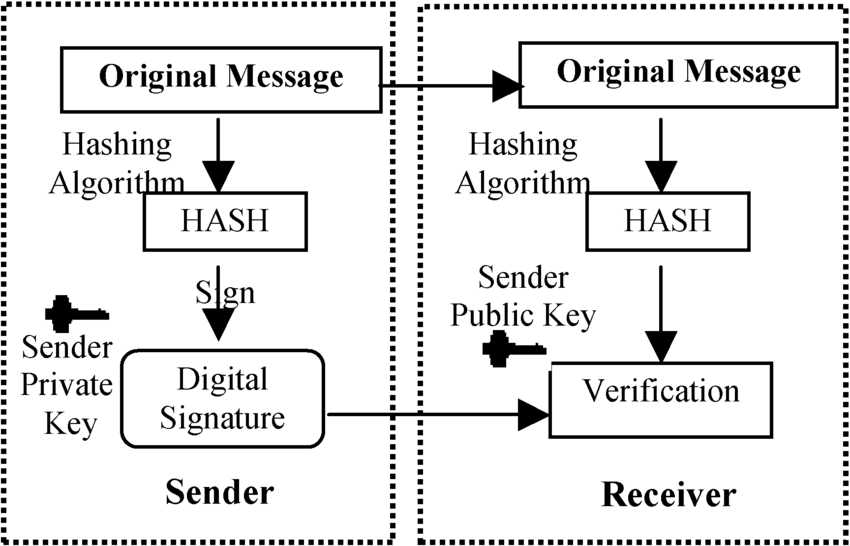
- Digital Signatures: Created using a sender’s private key and verified with their public key, digital signatures confirm the sender’s identity and the integrity of the data.
- Digital Certificates: Issued by CAs, certificates link a public key with an individual or organization, providing a trusted basis for verifying the identity in online interactions.
Authentication in Communication Protocols
Authentication is an essential component in secure communication protocols to prevent unauthorized access and impersonation:
- Transport Layer Security (TLS): Used in HTTPS, TLS provides server and, optionally, client authentication, ensuring secure and verified communication.
- Secure Shell (SSH): Provides secure remote access with user and server authentication, commonly using public key authentication.
- Kerberos: A network authentication protocol that uses tickets issued by a trusted server to authenticate users and systems on a network.
Key Management and Authentication
Secure key management is vital for authentication, especially in systems using digital certificates and keys:
- Secure Key Storage: Ensures that private keys and secret keys are securely stored, as they are critical for verifying identity.
- Certificate Authorities (CAs): CAs provide and manage digital certificates, offering a trusted framework for verifying identities.
Authentication vs. Other Cryptographic Principles
Authentication works in conjunction with other cryptographic principles to provide comprehensive security:
- Confidentiality: Ensures data privacy, while authentication verifies the identity of entities exchanging data.
- Integrity: Ensures data is unaltered, while authentication confirms the data’s source is legitimate.
- Non-Repudiation: Prevents entities from denying actions, while authentication verifies that the claimed entity is indeed the participant in the action.
Challenges to Authentication
There are several challenges to implementing robust authentication systems:
- Phishing Attacks: Attackers trick users into revealing their credentials. Education and multi-factor authentication can help mitigate this risk.
- Man-in-the-Middle (MITM) Attacks: Attackers intercept communications to impersonate one party. Protocols like TLS help prevent MITM by authenticating both parties.
- Key Compromise: If authentication keys are compromised, attackers can impersonate legitimate users. Secure key management reduces this risk.
Applications of Authentication
Authentication is essential in many domains to ensure secure and verified access:
- Banking and Financial Services: Verifies users’ identities before authorizing transactions, protecting accounts and sensitive information.
- Access Control Systems: Verifies user identities for secure physical or digital access, essential in corporate and government environments.
- Secure Email Communication: Verifies the sender’s identity, ensuring that sensitive information is exchanged with verified parties.
Future Considerations
As technology advances, authentication must adapt to new security challenges:
- Biometric Authentication: As biometric technology improves, it provides stronger, more user-friendly authentication methods like facial and fingerprint recognition.
- Quantum-Resistant Algorithms: With quantum computing’s potential, quantum-resistant algorithms are being researched to secure authentication keys and signatures against quantum attacks.